In short: an Indian head massage is a seated massage of your upper back, shoulders, upper arms, neck, scalp and often your face, usually given while you stay dressed, with or without oil.
What is an Indian head massage? It is a massage of the top half of your body, given while you sit upright in a chair. The therapist starts at your shoulders and upper back, moves through your upper arms and neck, spends a good stretch of time on your scalp and often finishes on your forehead, cheekbones and temples. You keep your clothes on, and oil in your hair is optional. It grew out of champi, a traditional head and hair massage from India, and it is sometimes sold under the name Champissage.
Our therapists give Indian head massage in London at your home, your hotel room or your workplace, anywhere within the M25. No table is needed, so it works as well at a desk or in a hotel armchair as in a dining chair at home.
Where does Indian head massage come from?
The treatment’s roots are in champi, an Indian tradition of head massage usually done with hair oil. In his book on the treatment, Narendra Mehta writes that the version practised by women in India was restricted to the head and hair, and that he extended the techniques to the neck, shoulders and upper arms.
Mehta came to England from India in the early 1970s to train as a physiotherapist, and he is credited with bringing Indian head massage to the UK. He trademarked his own version as Champissage and taught it at his London Centre of Indian Champissage.
Books and UK spa guides describe the treatment as based on Ayurveda, the traditional system of medicine in India, which is why you will also see it called an Ayurvedic head massage. Today’s version, as spa and training guides describe it, covers the upper back, shoulders, neck, head and face rather than the head alone.
How does an Indian head massage session run?
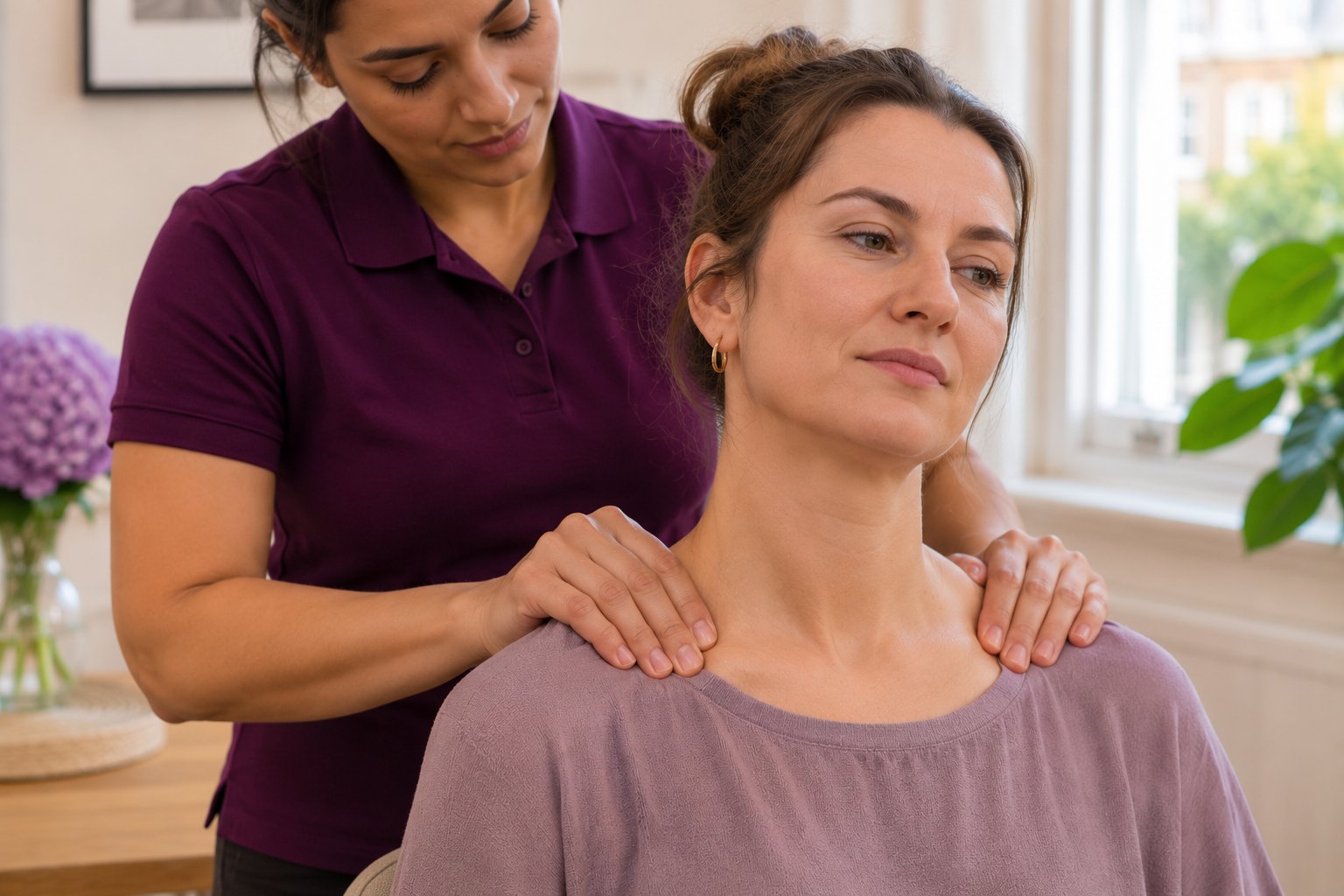
An Indian head massage works upwards, from your shoulders to your scalp and face, while you sit still. A typical session runs like this:
- A short chat first. Therapists usually ask which areas feel tight, what pressure suits you, and if you take any medication or have a health condition they should know about.
- Upper back and shoulders. Kneading and firm pressure across the tops of your shoulders and between your shoulder blades. This is often the firmest part of the session.
- Upper arms. Squeezing along your upper arms, between the shoulder and the elbow.
- Neck. Lighter work along the back and sides of your neck, sometimes with a slow, gentle stretch as the therapist tilts your head to one side. Say straight away if a stretch feels like too much.
- Scalp. Fingertip circles, rubbing, light tapping and gentle tugs on small sections of hair. If you have chosen oil, this is where it goes on.
- Face. Light, held pressure across your forehead, around your eyes and along your cheekbones, usually ending at your temples.
Which pressure points does it use?
Indian head massage includes steady fingertip pressure on points around the face and head. One UK training provider lists points on the forehead, around the eyes and on the cheekbones, and spa guides describe the treatment as acupressure on the head, face, neck and shoulders. What you notice is a held press for a few seconds at a time rather than a moving stroke.
Does an Indian head massage use oil?
It can, but it does not have to. Traditional champi uses hair oil, and many therapists offer oil on the scalp, but the treatment can also be given dry, through light clothing, as UK training guides and charity therapy services describe.
Oil changes the rest of your day. A spa guide warns that your hair can feel stiff afterwards and smell strongly of the oils used, so if you are heading out, either plan time to wash your hair or ask for a dry session.
Your therapist brings the oil, and one of the house oils is almond, so mention a nut allergy when you enquire; our mobile massage explainer lists the rest.
Do you sit or lie down for an Indian head massage?
You usually sit. Mehta gave the treatment in a chair, and UK guides describe it as a seated massage. You sit with your back straight and your feet flat on the floor, which lets the therapist reach your shoulders, neck and scalp from behind without you having to turn over.
If sitting upright for an hour is uncomfortable for you, ask whether the session can be given lying down. A table is only brought if you request one, so add that to your booking.
Do you stay dressed for an Indian head massage?
Yes. Because the massage covers only the top half of your body and can be done without oil, you do not need to undress for it. A loose top with an open neckline is the easiest for a therapist to work through; one spa guide points out that a polo neck is a bad idea.
If you want oil on your shoulders as well as your scalp, a vest or a wide neckline leaves that skin within reach without taking your top off. For oil massages where you do undress, see how towels and clothing work in a Swedish massage.
How long does an Indian head massage take?
At a salon or spa, an Indian head massage usually takes 20 to 45 minutes, going by the ranges UK spa and training guides give. Our shortest home visit is 60 minutes, and we do not offer a 30-minute booking, so a home session runs longer than those salon times. You can also book 90 or 120 minutes.
What does an Indian head massage feel like?
It feels varied, because the pressure changes as the therapist moves up your body. Your shoulders get slow, firm kneading. Your scalp gets quicker, lighter rubbing and small tugs at the roots of your hair, which feels closer to a long hairdresser’s scalp rub than to a back massage. Your face gets the lightest touch of all: still, held pressure with the fingertips.
Some of it is firm, particularly across the shoulders. Say straight away if any part is too much, and the therapist can ease off; how pressure is agreed is covered in more detail in our guide to deep tissue massage.
Is an Indian head massage the same as a head massage?
Not quite. A plain head massage may cover your scalp alone, while an Indian head massage also takes in your upper back, shoulders, upper arms, neck and face, and follows the champi tradition. A UK spa guide notes that many generic head and neck massages borrow from Indian head massage but leave out its firmer parts, such as the deep work on the shoulders.
Scalp massager or a therapist’s hands: what is the difference?
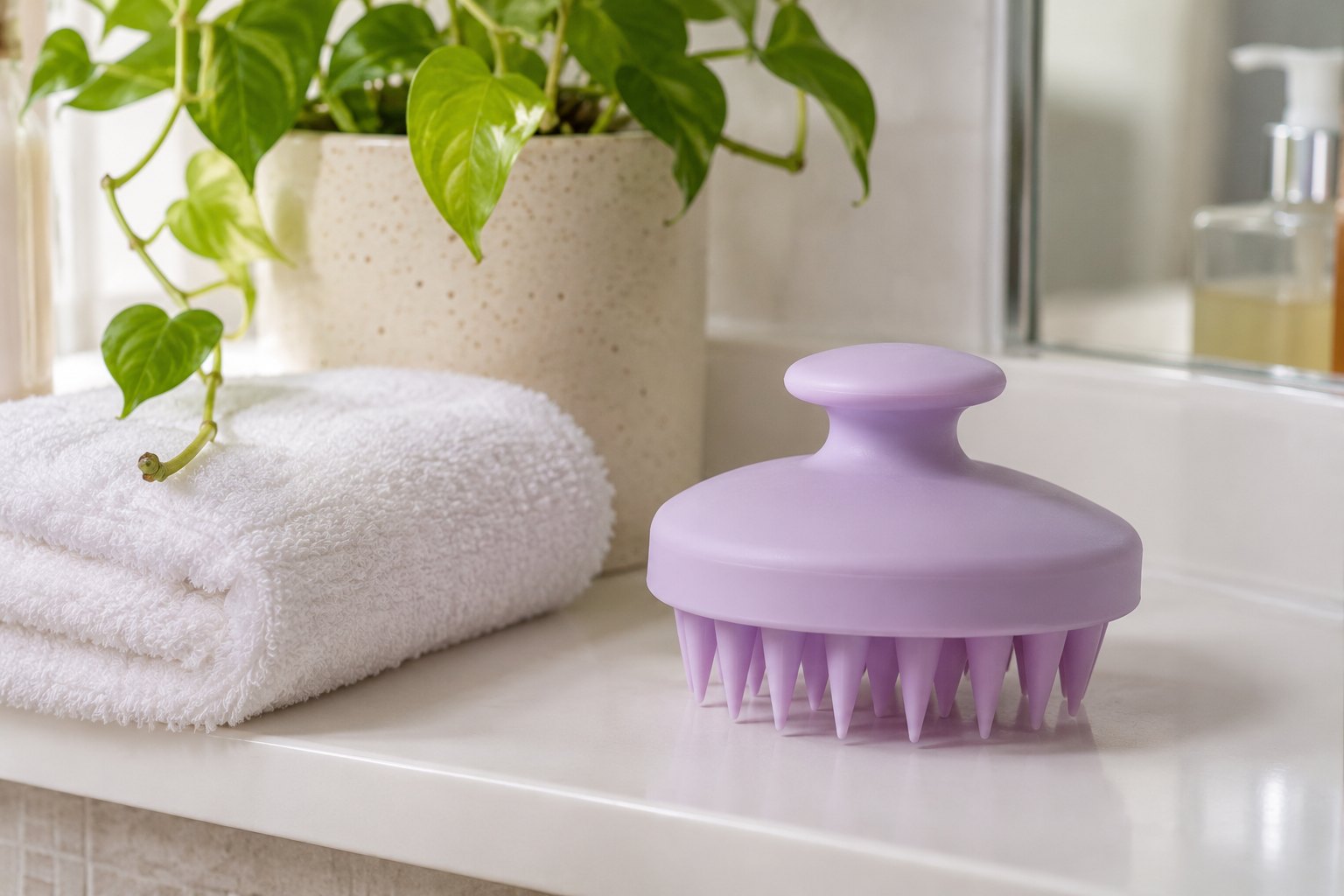
A scalp massager is a handheld tool you move over your own scalp, while an Indian head massage is a therapist working your shoulders, neck, arms, scalp and face for the whole appointment.
| Handheld scalp massager | Indian head massage | |
|---|---|---|
| What it covers | Your scalp, wherever you hold it | Upper back, shoulders, upper arms, neck, scalp and face |
| Who does the work | You | A therapist, while you sit still |
| Pressure | As firm as you press it | Changes by area, and you can ask for it lighter or firmer |
| Oil | Dry, or in the shower | With or without oil, your choice |
| Where | Anywhere, for a few minutes | At a salon, or at your home or office with a mobile therapist |
If you enjoy the feel of a scalp massager, it gives you a few minutes of scalp rubbing in the shower or at your desk. It is not a hair-loss treatment, and neither is a hands-on head massage. If you are worried about your hair, the NHS advice on hair loss is to see a GP.
Is an Indian head massage good for you?
An Indian head massage is something to book because you like how it feels; it is not a medical treatment, nor a treatment for headaches or migraine. The NHS headaches page advises a GP appointment if you regularly get headaches, or if a headache you have tried treating yourself is not getting better or is getting worse. For a headache and jaw pain when eating, or a sore or tender scalp, it advises an urgent GP appointment or a call to NHS 111, and for a headache that started suddenly and is extremely painful, 999 or A&E.
The practical downsides are small. If you choose oil, you will want to wash your hair afterwards. Firm work on the shoulders can feel intense if you are not expecting it, so say how firm you want it at the start.
Can you have an Indian head massage with a health condition?
It depends on the condition. A few, such as a fever or an active skin condition on your scalp or face, mean we cannot book, while others need a GP’s go-ahead first: see who we can and cannot book for a mobile massage.
Can you have an Indian head massage when pregnant?
If you are pregnant, tell us when you enquire and read our pregnancy massage at home page first.
Is an Indian head massage right for you?
Choose it if you want your shoulders, neck and head to have the full session, or a massage you can have sitting in a chair, fully dressed, at home, in a hotel room or at your desk. For a team at work, see our office massage in London page.
If your lower back or legs need attention as well, a full-body treatment will suit you better. See how the different types of massage compare before you choose.
Can you book an Indian head massage at home in London?
Yes. Three of our therapists offer Indian head massage, compared with all 42 for Swedish, so ask for it by name when you enquire. Qualifications in the team include a diploma that covers Indian head massage. Mention in your enquiry if you want a female or a male therapist.
Our 60-minute session, the Jazzy Hora, costs £65 between 8am and 11pm. Travel is additional: the minimum charge is £15 during the day and £20 at night. The longer sessions and the night rates are listed with our London massage prices, and our UK massage cost guide shows how a home visit compares with a salon. No card is needed to book; you pay when the therapist arrives.
Send your postcode and a date to book an Indian head massage at home, or book online and name the treatment.