In short: a sports massage is a firm, focused massage built around the exercise you do, with most of the session spent on the muscles your sport or training works hardest.
What is a sports massage? It is hands-on work on your muscles and the soft tissue around them, using many of the strokes found in other oil massages, but shaped by your activity: your therapist asks what you do and what is coming up, then spends the time on the parts of you that running, lifting, cycling or a weekly match load the most. You do not need to compete to book one. Our sports massage in London comes to your door anywhere inside the M25, and to a hotel room or your workplace too, so you can have it on your sofa the evening after a long run.
What does a sports massage involve?
A sports massage involves a short conversation about your training, then focused work on the muscles your training uses most, rather than an even pass over the whole body. The techniques are a small, familiar set:
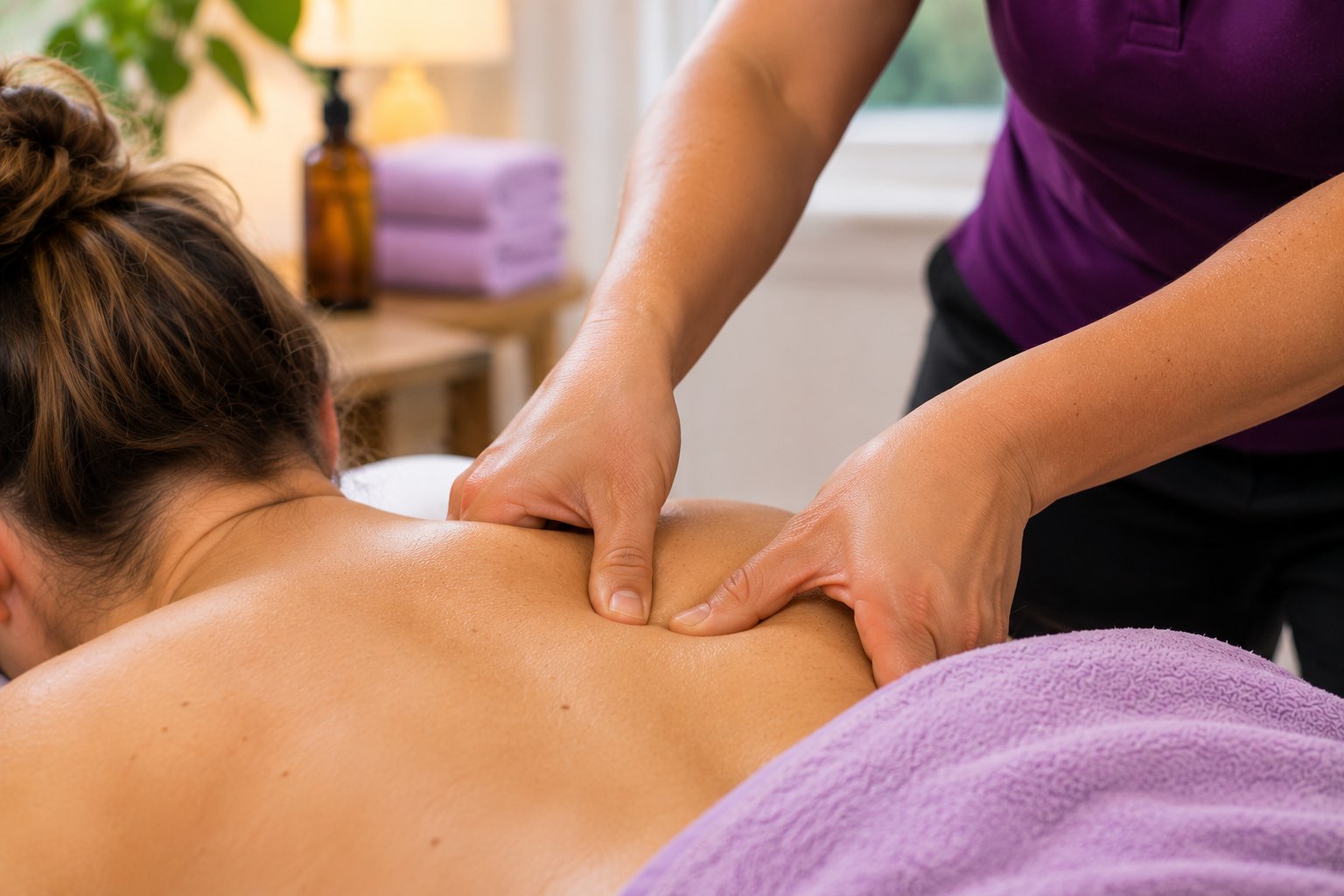
- Long, gliding strokes, with the hands sliding over the skin (effleurage). These usually open the work on each area and link one area to the next.
- Kneading (petrissage), where the muscle is lifted, squeezed and moved, then let go.
- Frictions: small, firm movements back and forth over one spot, using the pads of the fingers or thumbs.
- Hacking, where the edges of the hands strike the muscle in a light, quick, springy rhythm.
What makes it a sports massage is where and how long those strokes are used. If you run, it is common for the time to go on your calves, hamstrings and hips. If you swim or climb, the focus moves up to your shoulders and the muscles around your shoulder blades. Firm work on a busy muscle can feel uncomfortable for a moment, but it should not be very painful. The pressure is yours to set, and you can change it at any point: for how that conversation works, see our page on agreeing pressure with your therapist. For clothing and towels, our guide covers what to wear for a massage at home.
Pre-event, post-event and maintenance: what is the difference?
They are session formats named after when they happen relative to your training or your event. The UK occupational standard for sports massage therapists lists pre-event, inter-event, post-event and maintenance work as distinct kinds of session.
| Session | When it usually happens | What it is like |
|---|---|---|
| Pre-event | On the day of the event, shortly before your warm-up | Short and brisk; it comes before your warm-up and does not stand in for it |
| Inter-event | Between heats, rounds or matches on the same day | Brief, fitted into the gap |
| Post-event | Straight after the event, once you have cooled down | Short, often 10 to 15 minutes, given at or near the venue |
| Maintenance | Between training sessions, in an ordinary week | A booked session on the areas your training uses most |
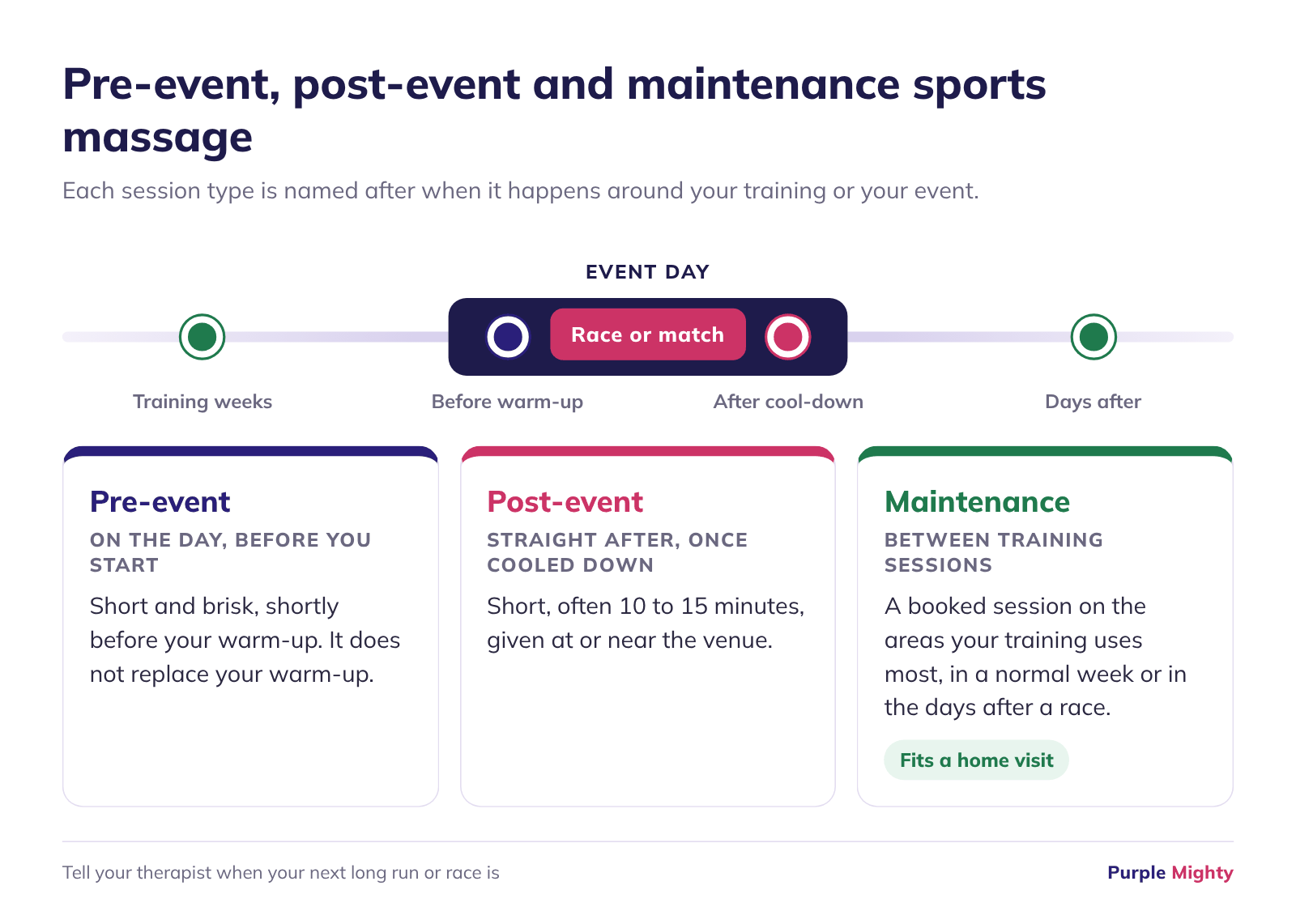
Pre-event and post-event work happens on the day, at or near the event. A home visit fits the maintenance format: an hour or more in a normal training week, or a session in the days after a race or match. If you are building up to the London Marathon or your first 10K, tell your therapist when your next long run or race is, so the session can be planned with it in mind.
Does sports massage help recovery?
The research on massage and sport is limited and mixed. A sports massage is not a treatment for injury, so book one because you like how it feels and it fits your training week. If you have hurt yourself, or something hurts every time you train, see a GP or a physiotherapist; for a fresh sprain or strain, the NHS advice is further down this page.
What will your therapist ask about your training?
Expect questions about what you do, how often, what is coming up and your health. These questions are standard: the UK occupational standard asks sports massage therapists to assess your general health and the issues linked to your activity, and to take your medical history, before they start. Typical questions:
- What sport or training you do, and how many times a week.
- Whether a race, match or heavy session is due in the next few days.
- Where you feel tight or sore, and whether it is one side or both.
- Any injury, operation or health condition, past or present, and any medication you take.
- How firm you like the pressure.
A one-line answer does the job: “I run three times a week, my left calf always feels tight, and I have a half marathon in a fortnight.” Give it even if you are not asked.
How does sports massage differ from deep tissue?
Deep tissue describes how the work is done, slow and firm; sports massage describes what it is planned around, your training. To choose between them for your week, read sports massage vs deep tissue.
Do you need to be an athlete to have a sports massage?
No. Sports massage suits anyone who exercises regularly, at any level. In London that takes in runners on the Thames Path or in Regent’s Park, cyclists who ride to work, gym regulars, and anyone with a five-a-side or netball game in the diary. If you train twice a week and want the session to centre on the muscles that training uses, sports massage is the right booking.
If you hardly exercise and mainly want firm pressure on a stiff back and shoulders, a deep tissue session or our Purple Classic may suit you better, and our guide to the different types of massage compares them. If back pain is why you are booking, read massage for back pain first.
Which injuries and health details should you mention first?
Tell your therapist about any injury, new or old, and anything that has felt different since you last trained. A few situations need your GP’s go-ahead first: if you have an acute injury, had surgery recently or are on blood thinners, check with your GP before booking and book once they are happy for you to have a massage.
A small number of conditions, such as a fever, mean we cannot book at all; you can read them all on our page about the conditions that rule out a mobile massage.
What if you have just hurt yourself?
Wait, and check with your GP before booking. For a sprain or strain, the NHS advice is to “try to avoid heat (such as hot baths and heat packs), alcohol and massages for the first couple of days.”
The NHS says to get help from NHS 111 in several situations, including if it is very painful or the pain is getting worse, if there is a large amount of swelling or bruising, or if you cannot put any weight on it or walk more than a few steps. It says to call 999 or go to A&E if, among other signs, you heard a crack when you were injured, the injured part has changed shape or is pointing at an odd angle, or it is numb, tingling or has pins and needles.
Once your GP is happy for you to have a massage, show your therapist exactly where the injury was, and ask them to leave that area alone if it still feels sore. During the session, say straight away if anything hurts in a sharp or unfamiliar way.
Is a sports massage the same as sports therapy?
No. Sports therapy takes wider training: The Society of Sports Therapists describes its members as allied health professionals able to assess and rehabilitate injuries, give immediate care when someone is hurt, and plan a return to training. A sports massage, including ours, is a massage. It is not an injury assessment, physiotherapy or a rehab programme. If a pain keeps coming back when you train, a GP or physiotherapist is the person to see first.
Who offers sports massage on our team?
Seven of the 42 therapists on our active team list sports massage, and one of them holds a VTCT Level 3 Diploma in Sports Massage. If you prefer a female or male therapist, say so when you enquire. Most of the team work in Central London and around where they live, so your postcode shapes who can come.
Seven is a smaller pool than the 23 who offer deep tissue, and booking one to two weeks ahead is what most of our clients do, so if you have a date in mind, around a race or a heavy block of training, enquire early. If you get on well with one therapist, request them again for your next session, subject to availability.
How long should a sports massage be?
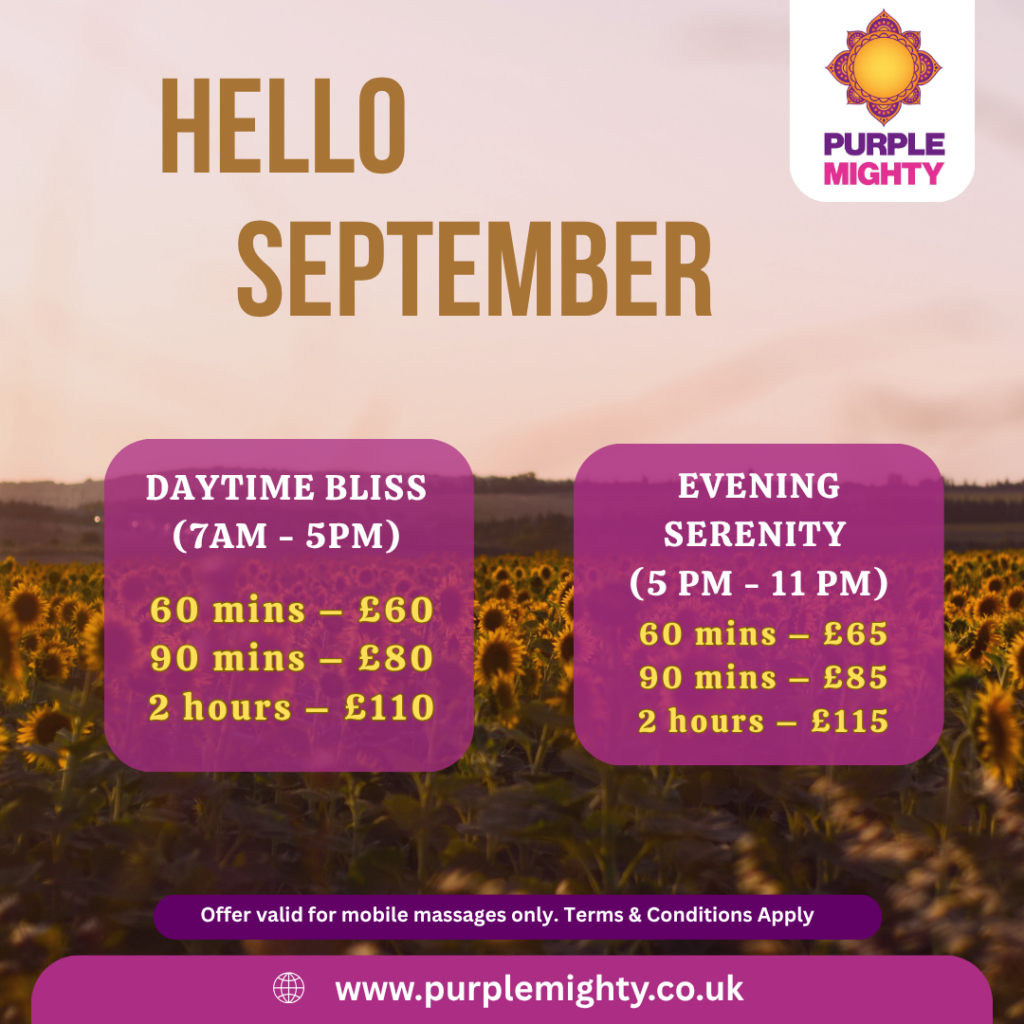
Our sessions run 60, 90 or 120 minutes, with no 30-minute option. Travel is additional: the minimum charge is £15 during the day and £20 at night. Choose the 90-minute Vintage 90 if you want time split between your legs and your upper body instead of spent on one area.
The 120-minute Mighty Dos and our night rates are listed on the London massage prices page. To see how clinic and salon prices for sports massage stack up, read UK massage prices by type and city.
Ready to book a sports massage around your training?
Choose a time that suits your training week, and mention your sport and where you want the focus when you enquire. If you are carrying a fresh injury, check with your GP first. Book a sports massage at home, starting with the Jazzy Hora: 60 minutes for £65 in the daytime, plus travel. There is no card to give at booking, and payment is on arrival.