In short: a deep tissue massage is a slow, firm massage focused on the areas you choose, at a pressure you set with your therapist and can change at any point.
What is a deep tissue massage? It is a massage done slowly, with firm, sustained pressure, where the time goes on the parts of you that you want worked on. Many of the strokes are the ones a Swedish massage uses, such as kneading and long strokes, but your therapist applies them more slowly and with more force. The session can cover your whole body or stay on one area, such as your back and shoulders. If you would like one without travelling, our deep tissue massage in London sends a therapist to you anywhere inside the M25, whether that is your flat, your hotel room or your office.
What happens in a deep tissue session?
A deep tissue session starts lighter and builds to firm work on the areas you picked. Therapists vary, but a session often runs like this.
- A short talk first. Therapists normally ask which areas you want worked on, which to leave alone and how firm you like it. Mention any injury, sore spot or area to avoid here. Some health conditions rule a massage out, and others need your GP’s go-ahead before booking: see the checks before you book a home massage.
- A lighter start. The first few minutes use a lighter touch, with broad strokes over the area, before the pressure builds.
- Slower, firmer work. The strokes slow down and the pressure goes in further: deep kneading and long, slow strokes, with more time on the spots you named. Expect the pressure to vary as your therapist moves from one area to the next.
- Check-ins along the way. Therapists usually ask how the pressure feels once the firm work starts. That is your moment to adjust it.
If you choose a single area, the whole hour can go there.
Should a deep tissue massage hurt?
No. Medical News Today describes deep tissue as slightly uncomfortable at times, especially on a tight spot, but says it should not be painful.
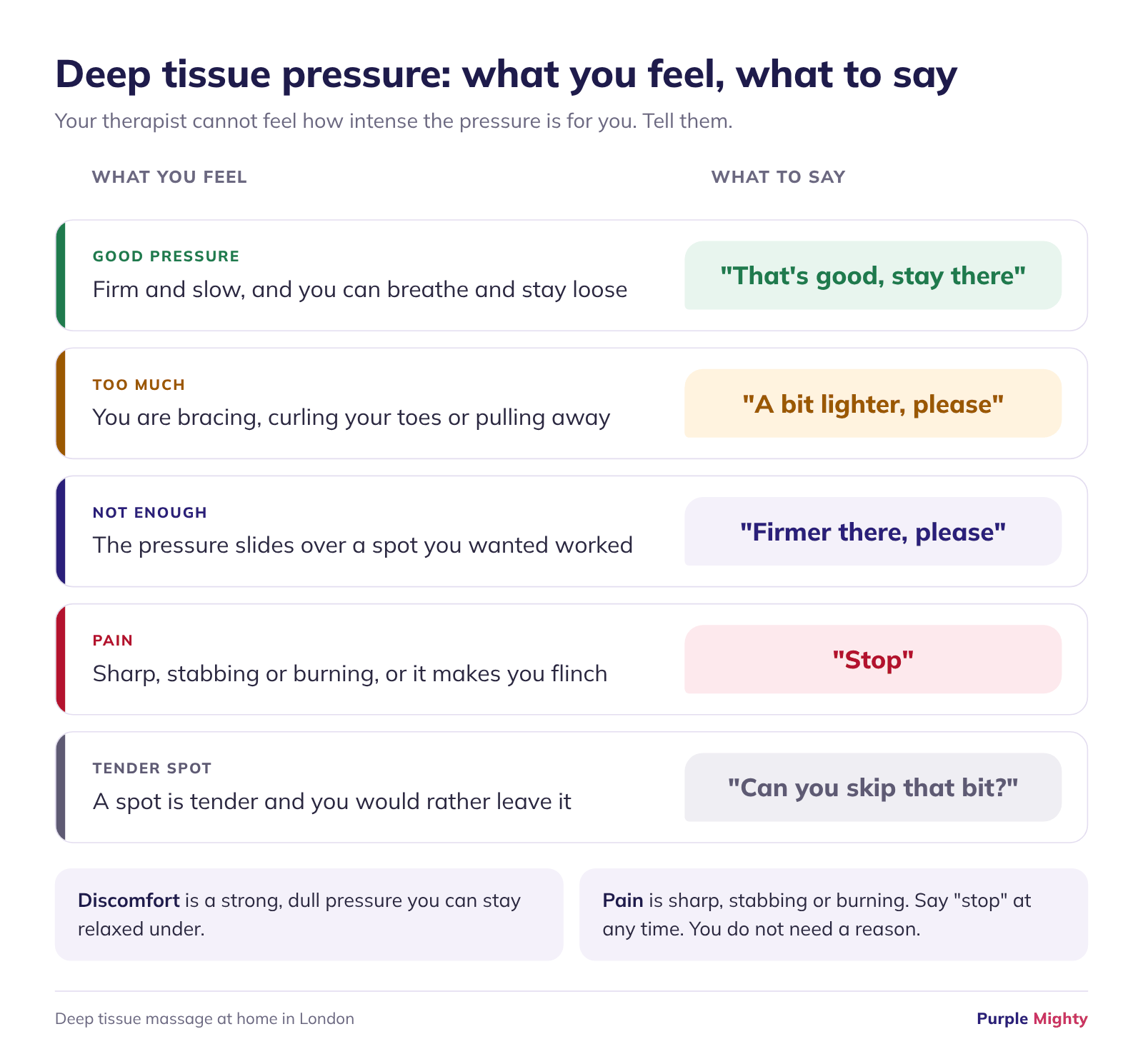
The difference is easier to feel than to define. Discomfort is a strong, dull pressure you can stay relaxed under, even if you are glad when it moves on. Pain is sharp, stabbing or burning, or it makes you flinch, pull away or brace against your therapist’s hands.
Your therapist cannot tell which one you are feeling. A massage therapist quoted by Cleveland Clinic puts it plainly: therapists “cannot feel the intensity of your pain response”. So say something the moment it tips from strong into painful. If you want the massage to stop, for a few seconds or for good, say “stop”. You do not need to give a reason.
| What you feel | What to say |
|---|---|
| Firm and slow, and you can breathe and stay loose | “That’s good, stay there” |
| You are bracing, curling your toes or pulling away | “A bit lighter, please” |
| The pressure slides over a spot you wanted worked | “Firmer there, please” |
| Sharp, stabbing or burning, or it makes you flinch | “Stop” |
| A spot is tender and you would rather leave it | “Can you skip that bit?” |
How do you agree the pressure, and change it mid-session?
You set a starting pressure before the massage, test it in the first few minutes of firm work, and change it as often as you like after that.
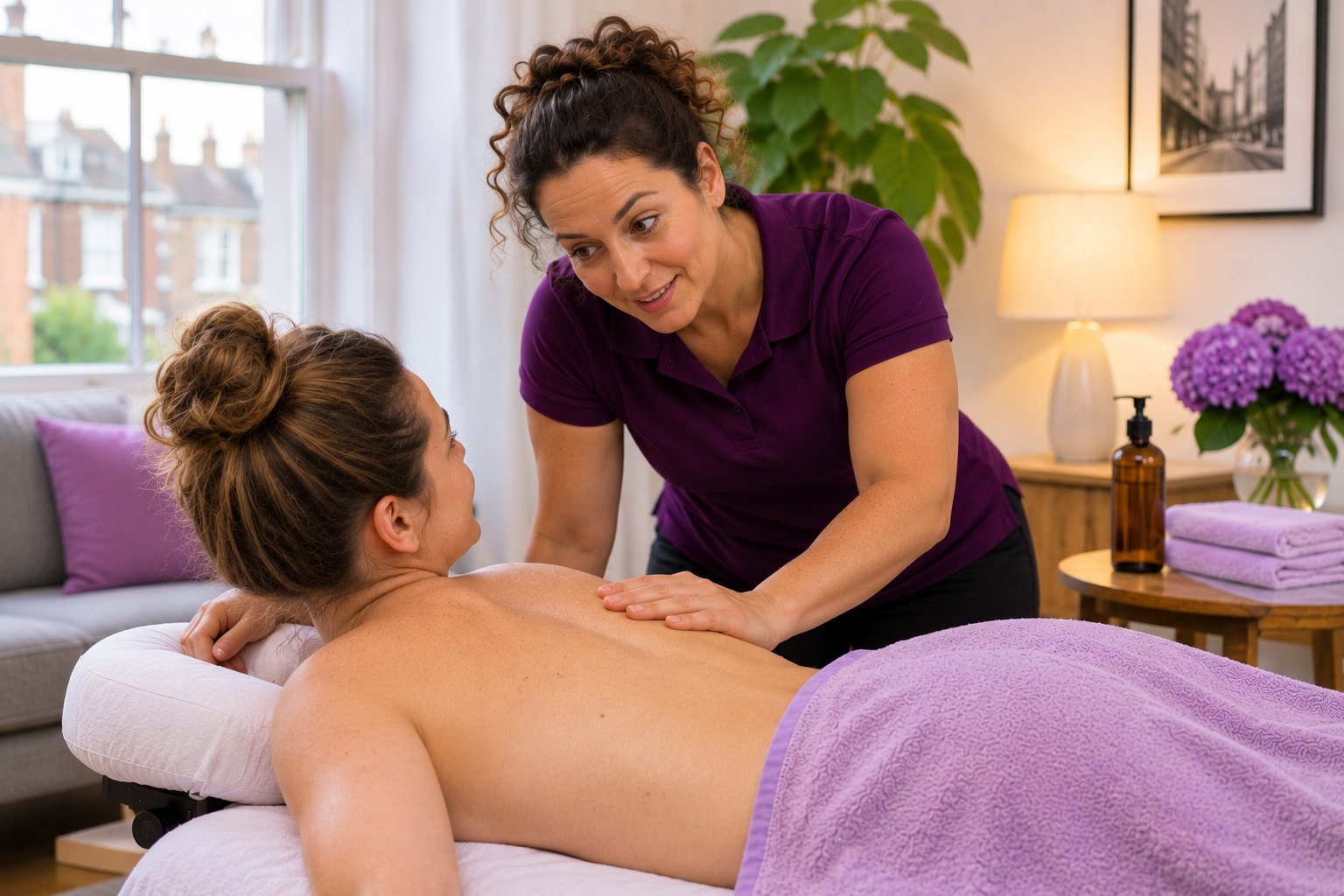
- Before the massage. Tell your therapist where you want the work and where to go easy. “Firm” means different things to different people, so if you have had a deep tissue massage before, describe how it compared with what you wanted. If a number is easier, a rough score out of ten works, with ten as the most you could take.
- Start firm or build up. Say which you prefer. Building up gives you a few minutes to find your level; starting firm suits you if you already know it.
- The first firm pass. Once the pressure has built, give an honest answer when your therapist checks. If they have not asked, tell them anyway. This is the easiest point to adjust, before you have spent twenty minutes at the wrong level.
- Spot by spot. The pressure does not have to be the same everywhere. Firm across the shoulder blades, gentle on the calves and nothing at all on the neck is a fair request.
- Any time after that. Change your mind as often as you need, including on a spot you already said was fine. Short words work best: firmer, lighter, slower, stay there, skip that.
- When talking is awkward. Lying face down, a sentence can be hard. Agree a simple signal at the start, such as raising a hand for “lighter”.
- Next time. Remember what worked, so you can tell your therapist in one line. If one therapist gets your pressure right, ask for the same therapist next time, subject to availability.
Is deep tissue massage the same as soft tissue massage?
No, but they are not opposites either. “Soft tissue” names the parts of the body being worked on, not a gentle pressure.
The Sports Massage Association uses the term soft tissue therapy, rather than soft tissue massage, for hands-on work on the body’s soft tissues, which it lists as primarily muscles, tendons and ligaments. Cleveland Clinic counts both deep tissue and Swedish massage as forms of soft tissue manipulation. So deep tissue is one kind of soft tissue work, not its firmer rival.
The phrase turns up in sport. Sport Wales, for example, has soft tissue therapists working with its athletes. Soft tissue massage is not a separate item on our treatment list. If a clinic or gym has offered you “soft tissue massage”, ask them what pressure and techniques they mean, then compare it with the options below.
How is deep tissue different from Swedish and sports massage?
Deep tissue is slower and firmer than Swedish, and less tied to training than sports massage.
A Swedish massage uses many of the same strokes, kept flowing over the whole body at a pressure that can run from light to firm. Deep tissue applies them more slowly and more forcefully, which is why it can feel uncomfortable in places; our Swedish massage explainer covers the gentler style in full.
Cleveland Clinic describes sports massage as similar to deep tissue, but zeroed in on the muscles your sport works hardest. Choose it when your training is the reason for the booking; what a sports massage involves explains the difference in more detail. On our team, 23 therapists list deep tissue and 7 list sports massage, so deep tissue gives you a wider choice of who comes.
For Thai, reflexology and the rest of the menu side by side, see our guide to the types of massage.
For a fuller side-by-side, see Swedish vs deep tissue massage and sports massage vs deep tissue.
Who is deep tissue for?
It suits you if firm pressure is what you enjoy and you have a clear idea of where you want the work. If the main point of the hour is to switch off, Medical News Today notes that deep tissue may be too strong for a purely relaxing massage.
If deep tissue sounds like more than you want, look at our Purple Classic massage. It is our own blend of deep tissue with relaxation massage, made to be not too soft and not too deep. Choose it if you have found Swedish too light in the past, but a full session of firm work sounds like a lot. Every therapist on our active team of 42 lists it, and it costs the same per session length.
If back pain is the reason you are booking, read what to know about massage for back pain first. With a slipped or herniated disc, read if massage can worsen a herniated disc before choosing firm pressure.
Will you feel sore after a deep tissue massage?
You might. Some people feel a little tender the next day, especially after firm pressure; if you do, tell your therapist before your next booking and ask for lighter work on that area. If pain is severe, unusual or does not ease, speak to a GP or call 111.
Aftercare, water and the toxins myth are covered in what happens after a massage.
What should you send when you book a deep tissue massage?
Your postcode, a preferred time, which areas to work on and how firm you like it. Mention it if you want a woman or a man to visit. Across our team, experience runs between about a year and 17 years, and some therapists hold diplomas that include deep tissue. Most of our therapists work across Central London as well as their own home area, and most clients book a week or two ahead.
Travel is additional: the minimum charge is £15 during the day and £20 at night. Your postcode decides the exact travel charge, and you pay when your therapist arrives; no card is needed to book. To see how that sits against salon prices, read how much a massage costs in the UK.
Book your deep tissue massage at home: 60 minutes, £65 by day, plus travel. Prefer to go straight to a time slot? Use our online booking page.