In short: a massage can leave your back sorer if the pressure, stretches or position are wrong, but the bigger risk is booking one when your symptoms need a doctor.
Can massage make a herniated disc worse? It can, if the session ignores how your back feels: deep pressure on the sore spot, a twisting stretch, or an hour face down when that position already hurts. Massage is not a treatment for a herniated disc.
If you are weighing up a deep tissue massage in London with a disc problem, start with the warning signs below.
Can massage make a herniated disc worse?
Yes, a session can leave you sorer, and the reasons are mostly about how it is done. Watch for three things:
- firm pressure worked straight into the painful part of your back
- stretches that twist or pull through your spine, which are part of some styles such as Thai massage
- staying in one position, often face down, for longer than your back is comfortable with
The NHS gives a useful rule for exercise with a slipped disc: the type of exercise is not important “as long as it does not cause pain or make your back pain worse”. During a massage, use your own version of that test: if something hurts, say so straight away and your therapist should stop or change what they are doing.
There is a second, more serious risk. Some back symptoms are a sign that you need medical help, and a massage booked in their place delays that. The warning signs are listed further down.
What is a herniated disc?
A herniated disc is when a soft cushion of tissue between the bones in your spine bulges outwards. The NHS uses the names slipped disc, prolapsed disc and herniated disc for the same thing. It is painful if it presses on a nerve, and not every slipped disc causes symptoms: the NHS notes that many people never know they have one.
When it does cause symptoms, the NHS lists:
- lower back pain, or neck pain
- problems bending or straightening your back
- numbness or tingling in your shoulders, back, arms, hands, legs or feet
- muscle weakness
- pain in the buttocks, hips or legs if the disc is pressing on the sciatic nerve (sciatica)
The NHS lists the causes as ageing, exercising too hard, lifting heavy objects the wrong way, sitting or driving for long periods, and being inactive or overweight. It also notes that nicotine weakens the disc tissue in the spine. A GP can usually diagnose a slipped disc from your symptoms, and may send you for an MRI scan if things do not get better.
When should you see a GP or call 999 instead?
If your back pain comes with any of the signs below, do not book a massage. Get medical help first.
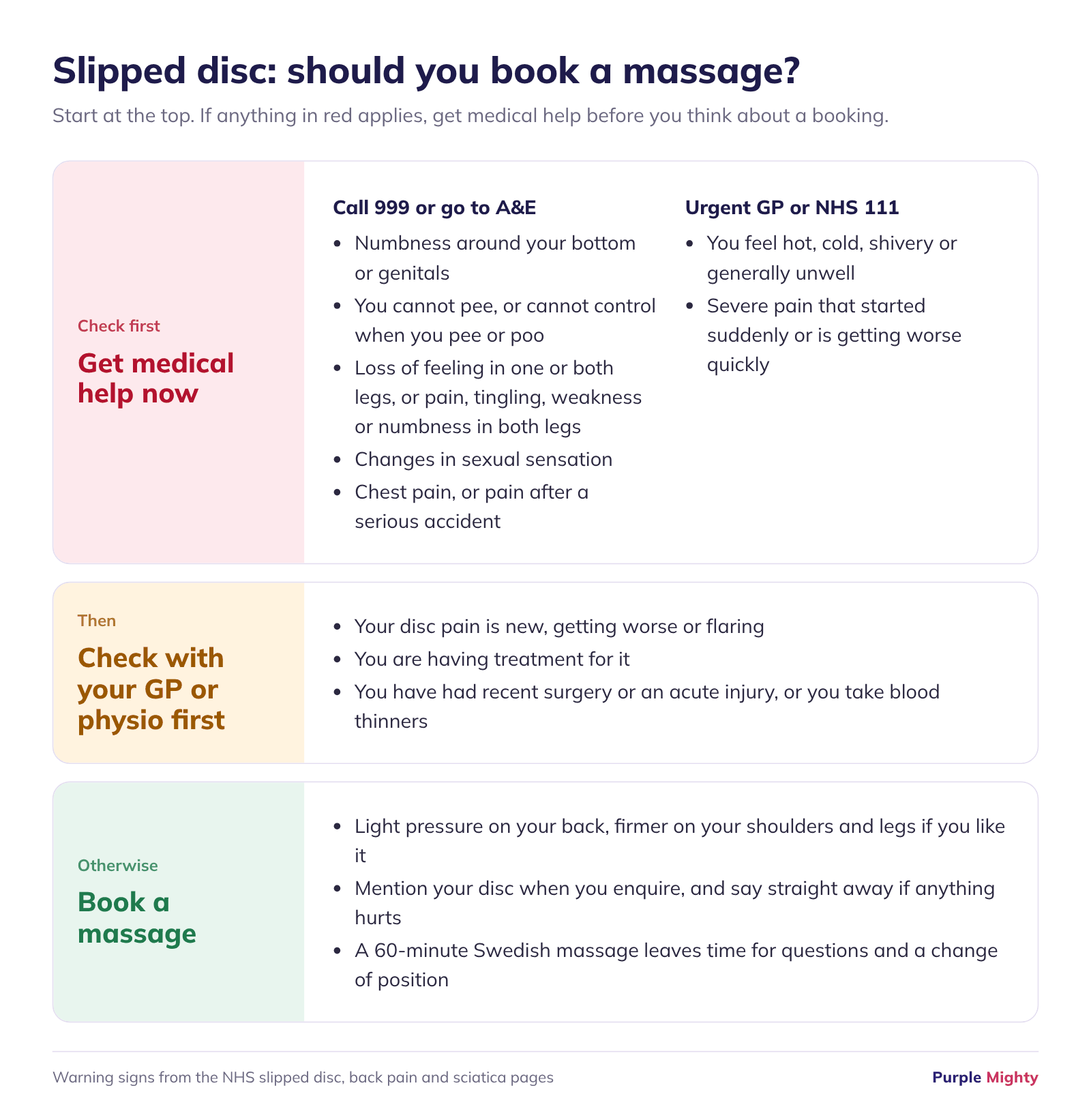
Call 999 or go to A&E if you have back pain with any of these signs, which come from the NHS slipped disc and back pain pages:
- numbness around your bottom or genitals
- you cannot pee, or cannot control when you pee or poo
- you lose feeling in one or both legs, or have pain, tingling, weakness or numbness in both legs
- changes in sexual sensation, or problems getting an erection or reaching orgasm
- chest pain
- the pain started after a serious accident, such as a car accident
The NHS sciatica page adds sciatica on both sides, and weakness or numbness in both legs that is severe or getting worse. Do not drive yourself; ask someone to drive you or call 999.
Ask for an urgent GP appointment or contact 111 if you feel hot, cold, shivery or generally unwell, or the pain is severe and started suddenly or is getting worse quickly.
See a GP if painkillers are not helping, the pain is not getting better after a few weeks, it is worse at night, you have lost weight without trying, or there is a swelling in your back. In many areas you can also refer yourself to NHS community musculoskeletal (MSK) services, such as physiotherapy, without seeing a GP first.
The same signs decide whether a session should stop. A massage should not start, or should stop, if any of them appear, if you notice new numbness, tingling or weakness, or if you feel sharp or spreading pain during the session. If your back is worse in the days after a massage, or you notice numbness or weakness you did not have before, follow the NHS advice above rather than booking again. A gentler massage is not the answer.
Can I get a massage with a herniated disc?
Often you can, provided none of the warning signs above apply. If you have a diagnosed back or disc condition, check with your GP or physiotherapist before booking if the pain is new, getting worse or flaring, or if you are having treatment for it. The same rule covers a slipped or bulging disc: what decides it is how you are right now, not the name of the diagnosis.
Some general health situations, such as recent surgery, an acute injury or blood thinners, mean checking with your GP before you book, and a few rule a massage out altogether; our guide to when not to book a mobile massage lists them.
If the pain is very bad right now, the NHS advice is to rest at first and then build up gentle exercise such as walking, swimming or yoga as soon as you can. A massage can wait until the worst has passed.
What should your therapist ask before starting?
Expect a few questions before any massage for someone with a disc problem. A good therapist will want to know:
- where the pain is, and whether it travels into a leg or an arm
- whether you have any numbness, tingling or weakness, and whether it is new
- who diagnosed the disc and what they said about massage
- whether you have had recent surgery, an injury or a fall
- which medicines you take, especially blood thinners
- which positions are comfortable for you: face down, on your side or sitting up
- how firm you want the pressure
Mention your disc when you enquire, and tell your therapist again before the session starts, including anything that has changed since you booked.
How is a massage adapted for a disc problem?
A sensible session with a disc problem is lighter around the painful area, leaves out twisting stretches, and lets you change position whenever you need to.
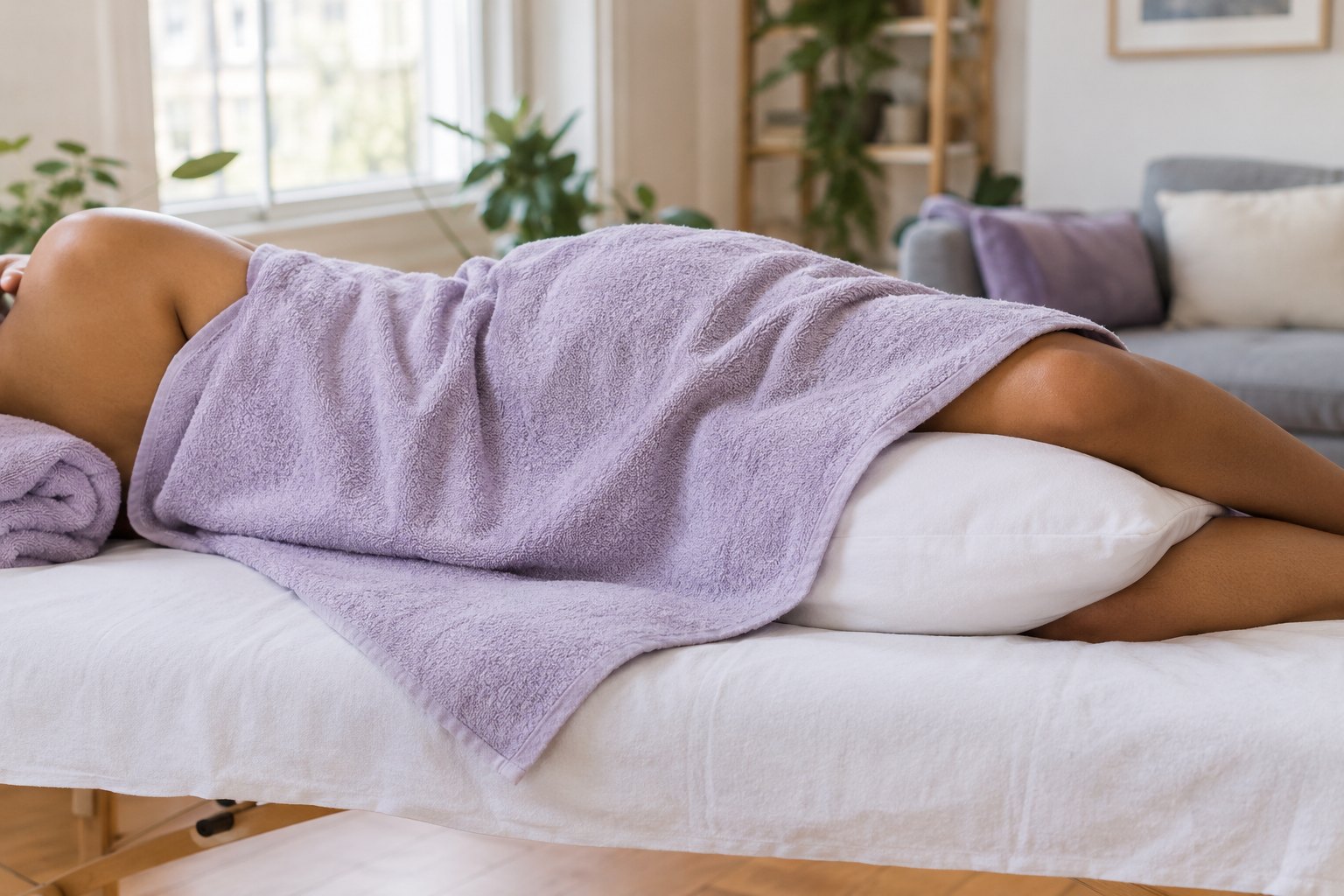
- Pressure. Lighter over and around the sore part of your back. If you like firm pressure, it can still go on your shoulders, hips or legs.
- Position. An hour face down is uncomfortable for some people with a sore back. Lying on your side with a pillow between your knees is an alternative, and you can turn over part way through. If getting down to the floor is awkward, ask for a table when you book; tables come on request.
- Stretches. No twisting or pulling stretches through your spine.
- Check-ins. Your therapist should check the pressure as they go. You can ask for lighter, firmer or a pause at any point.
Massage for slipped disc: what does the NHS say?
The NHS does not list massage as a treatment for a slipped disc. Its advice is to keep active, try anti-inflammatory painkillers such as ibuprofen if they are suitable for you, and speak to a pharmacist if you are not sure. A GP may prescribe stronger medicine for a short time or refer you for physiotherapy, and surgery is not usually needed.
Massage does appear in NHS guidance, but as part of physiotherapy. The NHS sciatica page describes physiotherapy as “including exercise advice and techniques like massage (manual therapy)”. The NHS back pain page lists manual therapy, “where a trained therapist massages and moves the muscles, bones and joints in your back”, as an option when back pain does not get better after a few weeks.
A relaxing massage at home is a different thing. A massage therapist does not diagnose or treat your disc, and a session with us is not a replacement for physiotherapy. Book one because you want a massage, not to fix the disc.
Can you massage a bulging disc?
A massage is not a way to work on the disc, whatever name it goes by. The NHS page covers slipped, prolapsed and herniated discs together and describes them as a disc that bulges outwards, but it does not use the term bulging disc. If your scan report or specialist uses “bulging” and “herniated” for different things, ask them what it means for you and whether massage is fine.
The NHS does not describe massage, or any hands-on technique, as a way to put a slipped disc back into place. It says a slipped disc usually gets better slowly with rest, gentle exercise and painkillers.
What a therapist can do is work the rest of your back, your shoulders, hips and legs at a pressure you are comfortable with, staying off the part that hurts.
Is deep tissue massage OK with a herniated disc?
Yes, as long as the warning signs do not apply and the firm work is kept away from the painful part of your back. Deep tissue is slow, firm pressure, and it does not belong on the sore spot. If the pain is new, getting worse or flaring, or you are having treatment for it, the GP or physiotherapist check comes first. Not sure what deep tissue feels like? See what a deep tissue massage involves first.
Start lighter than you normally would. You can ask for firmer pressure on your shoulders and legs and keep your lower back light. Or choose a lighter session instead:
- Swedish massage uses long, flowing strokes, and the pressure can stay light throughout.
- The Purple Classic blends deep tissue and relaxation and is pitched not too soft, not too deep.
Both are offered by all 42 of our active therapists, and 23 list deep tissue. Thai massage uses stretches and moves you through positions, so leave Thai massage until your GP or physio is happy with your back.
What about a herniated disc in your neck?
The same rules apply. The NHS lists neck pain, and numbness or tingling in the shoulders, arms and hands, among slipped disc symptoms. Look at the warning signs, check with your GP or physiotherapist first if the pain is new, getting worse or flaring or you are having treatment for it, and ask for light pressure around the neck. Our guide on whether it is dangerous to massage your neck covers the neck in more detail.
What should you book with a disc problem?
Book a 60-minute Swedish massage, with light pressure on your back and, if you like it, firmer work on the shoulders and legs. An hour leaves room for the questions at the start and for a change of position part way through. For help choosing between styles, see our guides to massage for back pain and the different types of massage.
Book a Swedish massage in London with a therapist who comes to you anywhere inside the M25, and mention your disc when you enquire. A 60-minute Jazzy Hora is £65 during the day. Travel is additional: the minimum charge is £15 during the day and £20 at night. There is no card needed to book, you pay on arrival, and a female or male therapist can be requested. Our London massage prices page has the full rates.