In short: gentle work on the back of your neck and shoulders is routine in a massage; the risks are firm pressure on the front or sides, cracking or forcing the neck, and symptoms that need a GP first.
Is it dangerous to massage your neck? Not when the massage stays on the back of the neck, the base of the skull and the tops of the shoulders, at a pressure you are happy with. The neck becomes the wrong place to massage when someone presses hard into the front or sides, when the head is twisted or the neck cracked, and when the pain or stiffness should be seen by a GP before anyone touches it.
Before you book a gentle Swedish massage in London, check where the line sits for your neck.
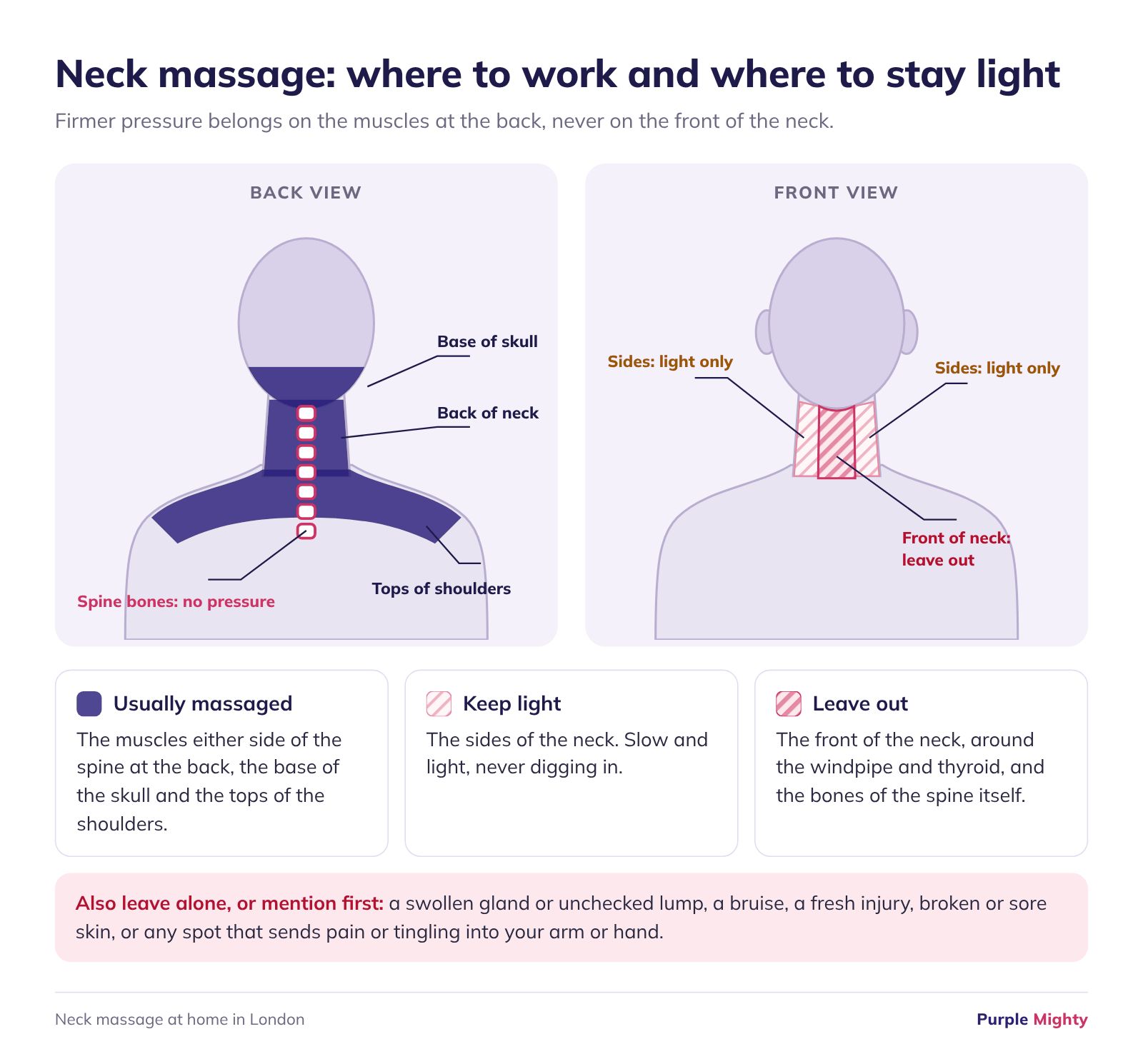
Where should you not massage on your neck?
Keep firm pressure off the front and the sides of your neck, and off the bones that run down the middle at the back. The NHS describes the thyroid as a small gland in the neck, “just in front of the windpipe”. The carotid arteries also run through your neck, and the lymph glands on each side of it can swell into “tender, painful lumps” when you have an infection, according to the NHS swollen glands page.
It is common for massage therapists to leave the front of the throat out altogether and keep any work on the sides of the neck light and slow. The places to leave alone, or to mention before a session starts:
- the front of your neck, around the windpipe and thyroid
- the sides of your neck, where pressure should stay light and never dig in
- the bones of the spine itself: neck work belongs on the muscles either side of it
- a swollen gland, which the NHS says to show a GP if it is “getting bigger” or has not gone down within a week, or if it feels hard or does not move when you press it, or any lump you have not had checked
- a bruise, a fresh injury, or skin that is broken or sore
- any spot where pressure sends pain, tingling or pins and needles down into your arm or hand
Which parts of the neck are usually massaged?
Neck work in a massage usually happens on the back of the neck, along the muscles either side of the spine, at the base of the skull and across the tops of the shoulders. The upper back and the area around your shoulder blades are often worked at the same time, and that is the better place for firmer pressure if you like it.
Can a neck massage cause a stroke?
Massage therapists keep work on the front and sides of the neck light, and they do not manipulate the neck: cracking, thrusting and forcing your head round are not part of a massage. If you want to be sure, ask for exactly that before the session starts.
The NHS stroke symptoms page uses the word FAST for the main signs of a stroke:
- face weakness: “one side of your face may droop (fall) and it might be hard to smile”
- arm weakness: “you may not be able to fully lift both arms and keep them there because of weakness or numbness in 1 arm”
- speech problems: “you may slur your words or sound confused”
- time to call 999
The NHS says to call 999 even if the signs have stopped, if they happened within the last 24 hours. Feeling dizzy or falling over, and a severe headache, are among the other symptoms it lists.
What about cracking your neck?
Cracking or manipulating your neck is not part of a massage, and it is not something to try at home with a towel or a friend’s hands. If you are thinking of having your neck adjusted by a professional, the NHS notes that chiropractors and osteopaths need to be registered by law, and says chiropractic or osteopathy may not be safe if you take blood thinning medicines or are at increased risk of bleeding or stroke.
When should you see a GP before a neck massage?
See a GP first if your neck matches any of the reasons the NHS gives for neck pain, and get urgent help for the injury and emergency signs below. The NHS neck pain page says to see a GP if:
- “neck pain or stiffness does not go away after a few weeks”
- “painkillers like paracetamol or ibuprofen have not worked”
- “you’re worried about the pain”
- “you have other symptoms, like pins and needles or a cold arm”, which the NHS says “could be something more serious”
After a neck injury. The NHS describes whiplash as “a neck injury caused by sudden movement of the head”, most often after a traffic accident or a slip or fall, and notes that symptoms can take several hours to start. If you have hurt your neck recently, get your GP’s go-ahead before you book. The NHS whiplash page lists the signs that need an urgent appointment with your GP, or NHS 111, when you have injured your neck:
- “you have severe pain despite taking paracetamol or ibuprofen”
- “you have tingling or pins and needles on 1 or both sides of your body”
- “you have problems with walking or sitting upright”
- “you have a sudden ‘electric shock’ feeling in your neck and back which may also go into your arms and legs”
- “your hands, arms or legs feel weak”
A stiff neck with a temperature. A fever already means we cannot book, and the NHS meningitis page says to get 999 or A&E help straight away for an adult who “has a stiff neck and cannot look at bright lights”, “has a very painful headache” or “has a rash that does not fade when you press it”.
A few other health situations mean we cannot book, or need your GP’s go-ahead first (taking blood thinners is one): see who should not book a mobile massage. If you have a diagnosed back or disc condition, check with your GP or physiotherapist before booking if the pain is new, getting worse or flaring, or if you are having treatment for it; for a slipped disc in your neck, read massage with a herniated disc too.
The NHS gives two more pieces of advice for any complementary therapy: “You should tell your therapist if you have any medical conditions, are taking any medicines or receiving other treatments”, and ask a GP about “symptoms that do not go away or keep coming back”, rather than only talking to a therapist.
Is it safe to massage your own neck at home?
A light self-massage on the back of your neck and the tops of your shoulders is a reasonable thing to try, as long as you keep to the same no-go areas a therapist would and stop when something feels wrong. Trim your nails and wash your hands first.
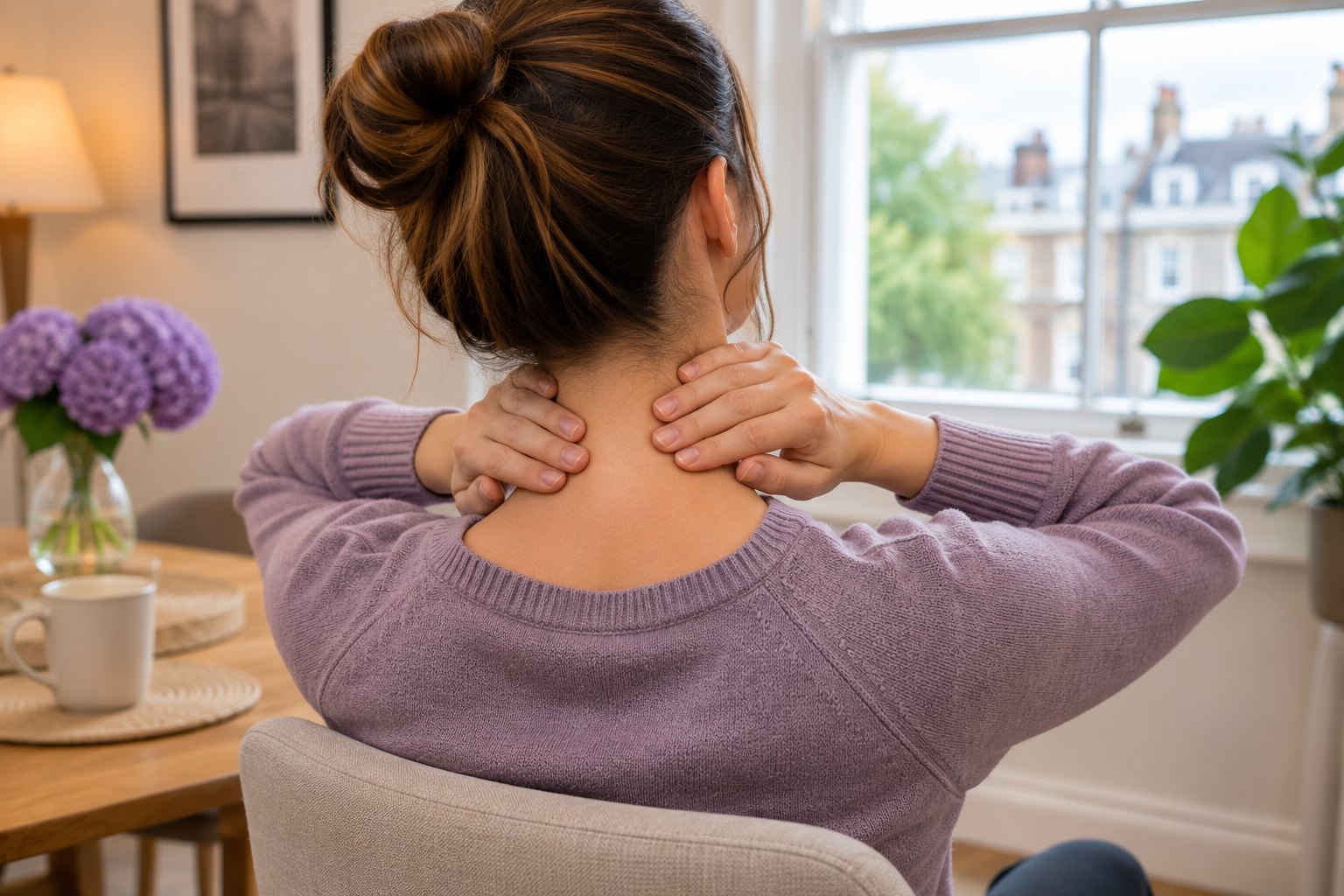
- Sit upright. Use a chair that supports your back, and let your shoulders drop.
- Start at the base of your skull. Place the flats of your fingertips either side of the bones at the back of your neck and make small, slow circles with light pressure.
- Work downwards. Move a finger’s width at a time towards the bottom of your neck, staying on the muscles beside the spine.
- Finish on your shoulders. Reach across with the opposite hand and squeeze the muscle along the top of your shoulder gently, then swap sides.
- Keep it short. A few minutes is enough at first.
Leave out the front and sides of your neck, any pressing with your knuckles or thumbs into one spot, and any rolling, pulling or cracking. Stop and check the NHS signs above if you feel pins and needles, numbness, dizziness or pain spreading into your arm.
Giving someone else a neck massage
Massaging a partner’s or friend’s neck follows the same rules: the back of the neck and the shoulders only, light pressure, and a check on how it feels as you go. Never pull or twist their head to stretch the neck, and stop the moment they say it hurts.
Is it safe to use a massage gun on your neck?
Only with care. Keep a massage gun or electric neck massager off the front and sides of your neck and off the spine, start on the lowest setting, and follow the maker’s instructions. Use it on the tops of your shoulders and upper back instead, and stop for the same signs as a hand massage.
What if your neck hurts after a massage?
Tell your therapist, and ask for lighter pressure or no neck work at all next time. If the pain lasts beyond a few weeks, or comes with pins and needles or a cold arm, see a GP, which is the NHS advice for any neck pain.
The NHS points out that most neck pain only lasts a few weeks. Its self-care steps are paracetamol or ibuprofen (or ibuprofen gel), heat or cold packs, a low, firm pillow and neck flexibility exercises, and it advises against a neck collar, unless a doctor tells you otherwise, because “it’s better to keep your neck moving”. Any FAST sign is a 999 call, whatever you think caused it.
How is your neck usually handled in a professional massage?
In a full-body massage, neck work is usually a short part of the session, done together with your shoulders and upper back, and you can ask for it to be left out or kept very light. Therapists commonly ask about injuries and health conditions before they start. Mention anything to do with your neck, including an old injury, and say which areas you would rather they avoid.
Pressure can be different on each part of the body. If you like firm work, ask for it on your shoulders and back and keep the neck lighter; our guide to how pressure works in a deep tissue massage explains how to agree it. A deep tissue massage at home can still suit you on that basis. If a stretch during the session feels like too much for your neck, say so, and your therapist should stop. When the neck is part of a wider back problem, see our advice on booking a massage with back pain.
Which massage should you book for gentle neck work?
Book a 60-minute Swedish massage and ask for light pressure on your neck. All 42 therapists currently on our team offer Swedish, and you choose whether a woman or a man comes. If you want firmer work on your back and shoulders with a lighter touch at the neck, try the Purple Classic, our house session that mixes relaxation with deep tissue work and aims for “not too soft, not too deep”.
A 60-minute Jazzy Hora is £65 during the day. Travel is additional: the minimum charge is £15 during the day and £20 at night. Our London massage prices page lists night rates and the longer sessions.
Book a Swedish massage at home with a therapist who travels to you inside the M25, and tell us about your neck when you enquire.