In short: massage is not a treatment for back pain, but you can book one for a desk-stiff back if no NHS warning sign applies; if a diagnosed condition is new, worsening, flaring or being treated, check with a GP or physiotherapist first.
Massage for back pain appears in NHS and NICE guidance only as one part of treatment. The NICE guideline on low back pain and sciatica says to consider manual therapy, including “soft tissue techniques such as massage”, “but only as part of a treatment package that includes exercise”. A massage at home is not that package. It can still be a reasonable booking when your back feels tight in a way you recognise and nothing below points to a doctor.
If your back has stiffened up over weeks at a desk and you like firm work, a deep tissue massage in London may suit you; check the three situations below first.
What do the NHS and NICE say about massage for back pain?
Both mention massage, and both mention it as part of treatment.
The NHS back pain page says back pain “usually improves within a few weeks but can sometimes last longer or keep coming back”. Its self-care advice starts with staying active and carrying on with your daily activities, plus:
- anti-inflammatory painkillers like ibuprofen, which may not suit everyone (paracetamol on its own is not recommended for back pain)
- checking with a pharmacist or GP if you are unsure which painkiller is right for you
- an ice pack, or a heat pack or hot water bottle, wrapped in a tea towel
- exercises and stretches for back pain, stopping and seeing a GP if the pain gets worse
- not staying in bed for long periods
If a few weeks pass without the pain getting better, the NHS says other treatments may be recommended. These include group exercise sessions and physiotherapy, cognitive behavioural therapy, and manual therapy: “where a trained therapist massages and moves the muscles, bones and joints in your back”.
A booked massage at home is not physiotherapy or manual therapy in that sense, and it is not a treatment for back pain. How a massage feels on a stiff back is a separate, personal question.
Which massage booking suits your back?
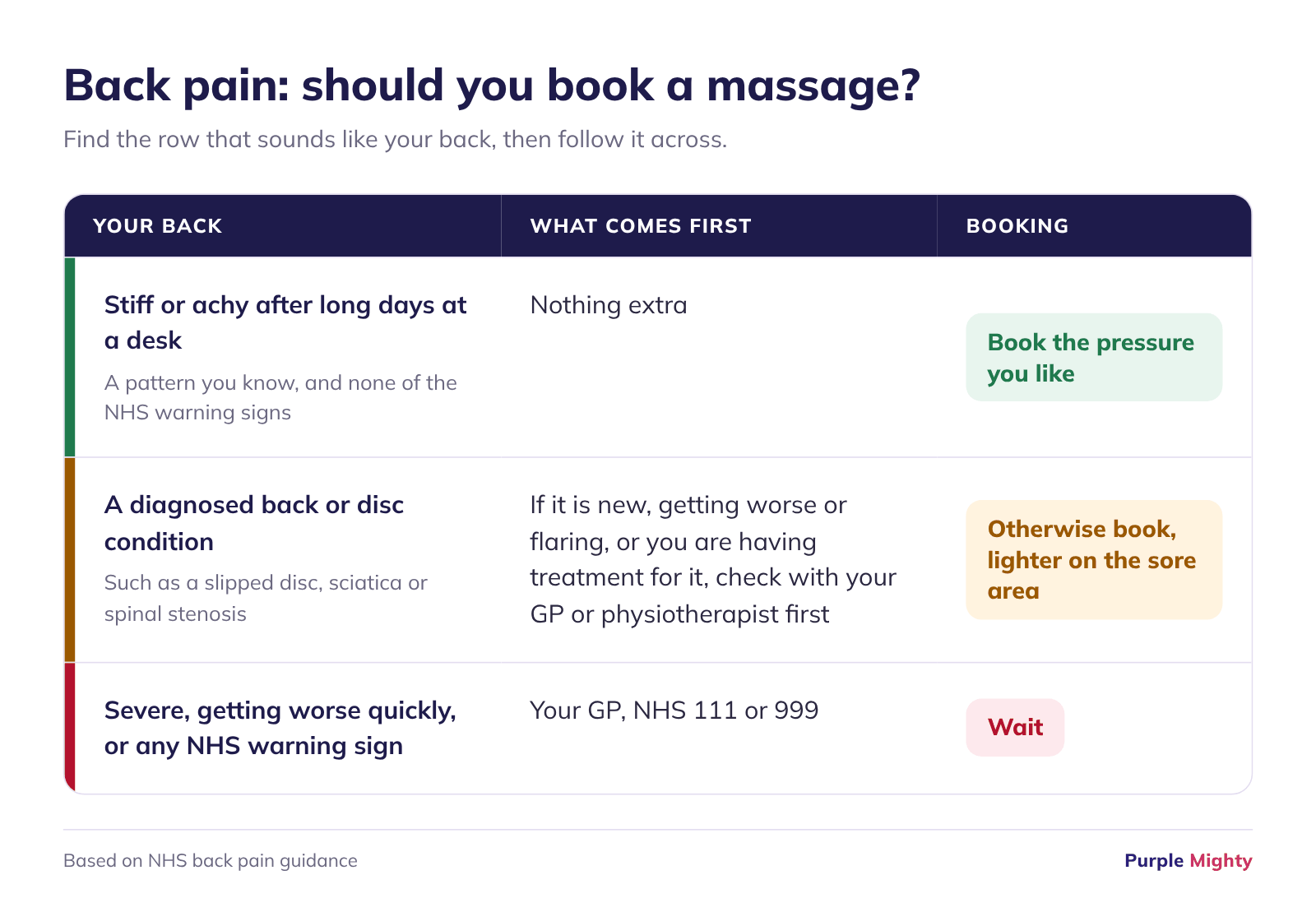
Book the pressure you like if your back is stiff from desk work and no warning sign applies; check with your GP or physiotherapist first if a diagnosed condition is new, getting worse or flaring, or you are having treatment for it; wait if the pain is severe or getting worse quickly.
| Your back | What comes first | Booking |
|---|---|---|
| Stiff or achy after long days at a desk, a pattern you know, none of the warning signs below | Nothing extra | Book the pressure you like |
| A diagnosed back or disc condition, such as a slipped disc, sciatica or spinal stenosis | If it is new, getting worse or flaring, or you are having treatment for it, check with your GP or physiotherapist first | Otherwise book, lighter on the sore area |
| Severe, getting worse quickly, or any NHS warning sign | Your GP, NHS 111 or 999, as listed below | Wait |
Separately from your back, a few general health situations rule a massage out or need your GP to agree first; you will find them in our mobile massage guide.
A stiff back after long days at a desk
If your back feels tight after hours in a chair, the feeling is familiar and none of the warning signs apply, you can book a massage because you want one. Go in expecting a massage, not a fix. Keep up the movement the NHS suggests alongside it: its back pain page says walking, swimming, yoga and pilates “may also help ease back pain”.
Choose the pressure by what you enjoy. If you are not sure how firm to go, our deep tissue massage guide explains how pressure is agreed and changed during a session.
A diagnosed back condition
If you have a diagnosed back or disc condition, check with your GP or physiotherapist before booking if the pain is new, getting worse or flaring, or if you are having treatment for it. Otherwise you can book, with lighter pressure on the sore area. The NHS lists a slipped disc, sciatica and ankylosing spondylitis among the medical conditions that can cause back pain.
A slipped disc is also the most common cause of sciatica, according to the NHS. Disc questions, including what to avoid in a session, are covered in our guide on whether massage can make a herniated disc worse.
If you are already seeing a physio, a massage at home sits outside that plan rather than inside it. Tell your physio you are thinking of booking one.
New, severe or worsening pain
Severe pain that starts suddenly, or pain that is getting worse quickly, is a reason the NHS gives to get an urgent GP appointment or help from NHS 111. Sort that out before thinking about a booking.
If the pain is new but milder, the NHS notes that back pain often gets better on its own, and says to see a GP if it does not improve after treating it at home for a few weeks.
Which back pain signs mean a GP, 111 or 999 first?
If any of the signs below applies to you, get medical help and leave the massage for later.
Call 999 or go to A&E. The NHS back pain page lists back pain with:
- pain, tingling, weakness or numbness in both legs
- a loss of feeling around your genitals or anus
- changes in your bladder or bowels, such as difficulty peeing, or peeing or pooing yourself
- changes in how your penis or vagina feels during sex, not being able to get or keep an erection, or not being able to orgasm
- chest pain
- pain that started after a serious accident, such as a car accident
For sciatica, the NHS sciatica page also lists sciatica on both sides, severe or worsening weakness or numbness in both legs, numbness around or under your genitals or around your bottom, and, when this is not normal for you, finding it hard to start peeing, not being able to pee, or not noticing or controlling when you pee or poo. The NHS says not to drive yourself to A&E: get someone else to drive you, or phone 999 for an ambulance, and take your medicines with you.
Get an urgent GP appointment or help from 111 if, along with back pain, you feel generally unwell, hot, cold or shivery, or the pain is severe and came on suddenly, or it is worsening fast.
See a GP if your back pain:
- has not improved after treating it at home for a few weeks
- is stopping you doing your day-to-day activities
- worries you, or you are struggling to cope
- comes with weight loss you were not trying for
- comes with a lump or swelling in your back, or your back has changed shape
- does not improve after resting, or is worse at night
- is worse when you sneeze, cough or poo
- is coming from the top of your back, between your shoulders, rather than your lower back
Many areas also let you go straight to physiotherapy and other help from NHS community musculoskeletal (MSK) services, with no GP referral needed.
Is massage good for lower back pain?
Not as a treatment on its own. NICE’s guideline is written specifically for low back pain and sciatica in people aged 16 and over. The NHS calls lower back pain “very common”, and says it usually improves within a few weeks.
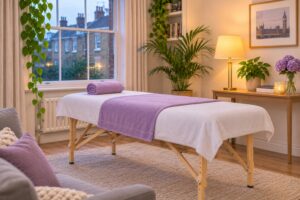
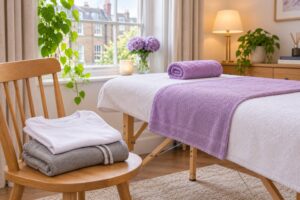
For booking, lower back pain follows the same three situations as any back pain. If it is the familiar stiffness and nothing on the lists above applies, you can book. If lying face down for an hour is uncomfortable for your lower back, tell your therapist at the start so you can change position. A massage table is available on request, so if the floor is hard on your back, request one at booking.
Should you book a massage with sciatica?
Yes, if you have none of the warning signs listed above, and after a check with your GP or physiotherapist if your sciatica is new, getting worse or flaring, or you are having treatment for it. The NHS describes sciatica as what happens when the sciatic nerve, which runs from your lower back to your feet, is irritated or compressed. Its symptoms usually affect your bottom and the back of one leg, often down to your foot and toes:
- a sharp, burning pain down the back of the leg
- tingling, like pins and needles
- numbness
- weakness
The NHS also says: “You probably do not have sciatica if you only have back pain.”
Massage does appear in NHS sciatica advice, but inside physiotherapy, which the NHS describes as “including exercise advice and techniques like massage (manual therapy)”. Physiotherapy is free on the NHS, though the NHS notes that waiting times can be long, and in many areas you can refer yourself. A home massage is not a stand-in for it.
When you book, tell your therapist where the leg symptoms run. If numbness, tingling or weakness appears during the session, or gets worse, tell your therapist at once and stop.
What about a pinched nerve?
If you have been told you have a pinched or trapped nerve in your lower back, read the sciatica advice above: the NHS back pain page describes sciatica as “a trapped nerve”. The same rule as for sciatica applies. If your symptoms are in your neck, read our neck massage safety guide.
What is the best massage for back pain?
There is no style we can honestly call the best for back pain, because massage is not a treatment for it. What you can choose is how the session feels, and that comes down to pressure:
- Firm and slow. Deep tissue, which 23 of our 42 active therapists list.
- Light and flowing. Swedish massage, offered by every one of our 42 therapists.
- In between. The Purple Classic, our own mix of deep tissue and relaxation: not too soft, not too deep. Every therapist offers it too.
With a diagnosed condition, start lighter where your back is sore. A firmer touch on your shoulders and legs is still yours to ask for. For how each style compares beyond pressure, see our guide to the main types of massage.
What should you tell your therapist about your back?
Tell them everything relevant before the session starts, even if you mentioned your back when you enquired. Therapists usually ask about health conditions before they begin, but you do not need to wait for the question. Cover:
- where it hurts, and whether anything runs down a leg
- any diagnosis, and what your GP or physio said about massage
- surgery, an injury or a fall in recent months
- blood thinners or other medicines
- positions that hurt, such as lying face down
- how firm you want the pressure on your back compared with the rest of you
During the session, speak up the moment anything hurts. Your therapist can change what they are doing or stop.
Can you book a massage for a stiff back at home in London?
Yes, if no warning sign above applies and, for a diagnosed condition that is new, getting worse, flaring or being treated, your GP or physiotherapist is happy for you to go ahead. Our therapists come to you anywhere inside the M25, at home, in a hotel or at work.
For the gentlest start, book a Swedish massage at home and ask for lighter pressure around the sore area. If your back is only stiff from desk work and you like firm pressure, book a deep tissue massage at home instead. A 60-minute Jazzy Hora is £65 during the day, paid on arrival; you do not need a card to book. Travel is additional: the minimum charge is £15 during the day and £20 at night. Mention your back when you enquire, and again when your therapist arrives.